
- Compare agents
- Online valuation
- Explore my area
- Home toolkit
- News & guides


- Estate agents by area
- Sold house prices by area
- Estate Agent ValuationRequest an in-person valuation with an agent to discover your property's true market value.
- Online Valuation ToolGet a free instant estimate of your home's value.
- EPC CheckerFind out if your home has a valid Energy Performance Certificate.
- Listing MonitorAlready on the market? See how your online property advert is performing.
- Selling guides
- Estate agent guides
- Mortgage advice
- Conveyancing guides
- Property news See All News & Guides
Agent shortlist
HouseWorth
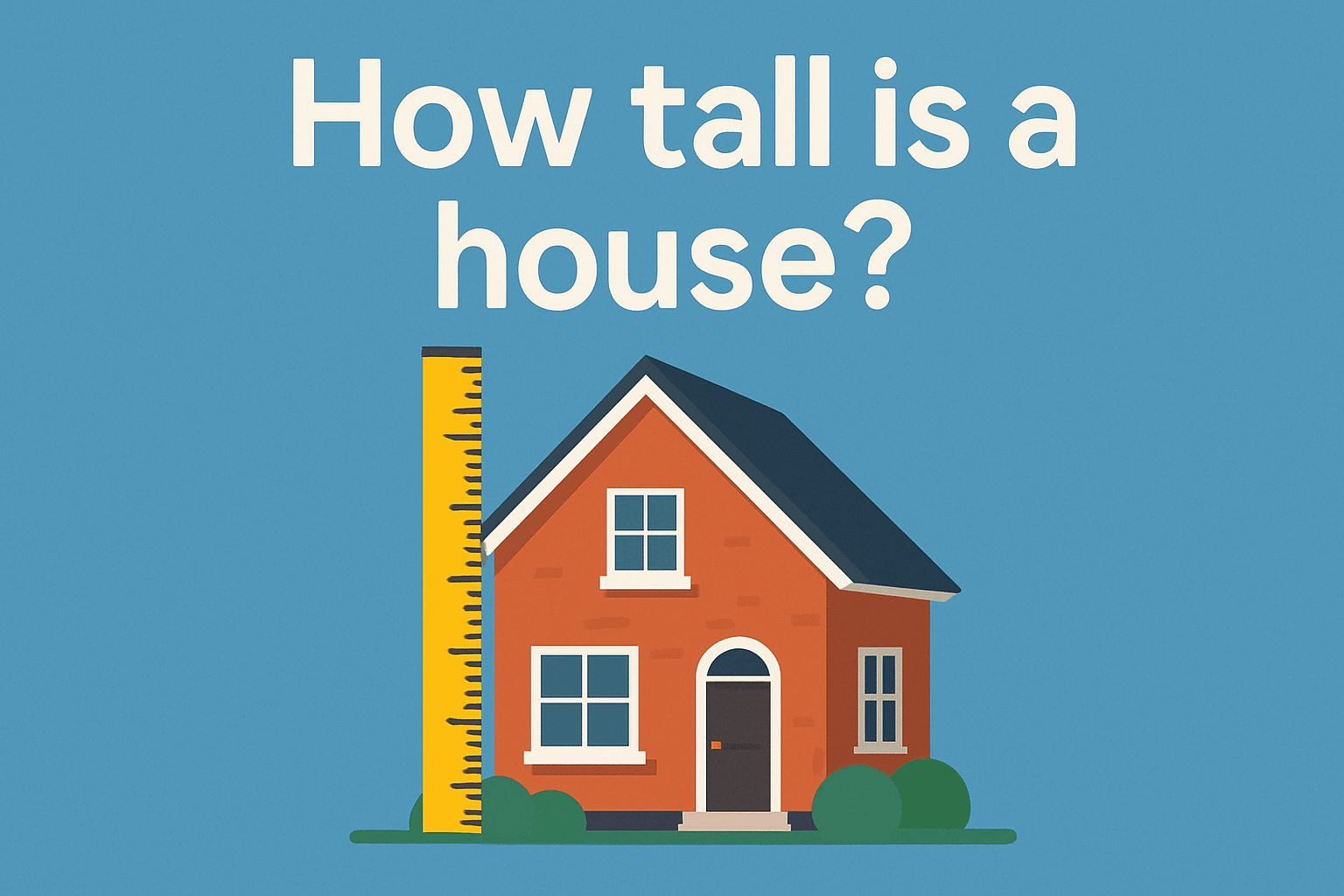
- How tall is a house?
Estimated reading time: 5 minutes
Table of contents
When you step back and admire a row of homes on your street, you might wonder: how tall is a house, really? The answer isn’t always straightforward, because a home’s height depends on factors like architectural style, number of floors, roof type, and local building regulations. In this article, we’ll explore typical residential heights, the factors that affect them, and how you can measure a home’s height—whether you’re a buyer comparing properties or simply curious about your neighbourhood skyline.
Typical Heights by Number of Storeys
A quick way to estimate “how tall is a house” is by counting its storeys. Here’s a rough guide:
- Single-storey homes: 3 to 4 metres (10 to 13 feet)
- Two-storey homes: 6 to 8 metres (20 to 26 feet)
- Three-storey homes: 9 to 12 metres (30 to 39 feet)
- Loft or attic conversions: add an extra 2 to 3 metres (6 to 10 feet)
Bear in mind these figures include standard floor heights plus the roof’s peak. For example, a two-storey home with a pitched roof might measure closer to 8 metres at its highest point.
Factors Influencing House Height
- Floor-to-ceiling height
- Older homes (Victorian, Edwardian) often have higher ceilings—3.5 metres (11.5 feet) or more per floor.
- Modern builds may stick to 2.4 to 2.7 metres (8 to 9 feet).
- Roof design
- Pitched roofs: add height at the centre ridge—often 1.5 to 3 metres (5 to 10 feet) above the top floor ceiling.
- Flat roofs: minimal additional height, usually just roof thickness (0.2 to 0.4 metres).
- Basements and cellars
- Often excluded from “storey” counts but add 2 to 3 metres (6 to 10 feet) below ground level.
- Extensions and loft conversions
- A loft conversion could add one storey’s worth of height internally, yet externally it alters the roof line rather than the overall building height.
- Local planning regulations
- Maximum permitted heights vary by council. In conservation areas, for instance, you may be limited to 8 metres for two storeys plus roof.
How to Measure House Height Yourself
If you want to know “how tall is a house” on your own street, try these methods:
Laser distance meter
Point the device from ground level to the roof ridge. It gives you a direct reading in metres.Smartphone apps
Apps like Measure (iOS) or AR Ruler (Android) use augmented reality to estimate heights. They’re less precise but handy on the go.Simple trigonometry
- Measure a horizontal distance (d) from the house—say, 10 metres.
- Use a protractor or smartphone inclinometer to find the angle (θ) between ground level and the roof ridge.
- Height ≈ tan(θ) × d.
This won’t be exact but gives a reasonable approximation.
Why Knowing House Height Matters
- Planning extensions: You need to stay within height limits specified by local planning permission.
- Valuation purposes: Ceiling heights can influence a home’s market value—taller rooms often feel more spacious and desirable.
- Energy efficiency: Greater volume means more air to heat and cool, affecting running costs.
- Neighbour relations: Extensions or loft conversions can cast shadows. Understanding height helps avoid disputes.
Average House Heights in Different Styles
| Style | Storeys | Approx. Height (m) | Roof Type |
|---|---|---|---|
| Bungalow | 1 | 3.5 – 4 | Pitched/Flat |
| Semi-detached | 2 | 6 – 8 | Pitched |
| Detached | 2 – 3 | 8 – 12 | Pitched/Gable |
| Victorian townhouse | 3 | 9 – 11 | Mansard |
| Modern flat block | 3 – 4 | 12 – 16 | Flat |
Note: These figures are approximate; local regulations and architectural variations will affect actual heights.
Impact of Roof and Loft Conversions
Loft conversions are one of the most popular home improvements. They can:
- Add valuable living space: Often a bedroom, office, or bathroom.
- Change external appearance: Dormer windows, rooflights, and raised ridges can alter the building’s profile.
- Affect planning permissions: In some areas, permitted development rights cover loft extensions as long as overall height doesn’t exceed the original ridge.
When considering “how tall is a house” after a loft conversion, measure from original ground level to the new ridge height. You may find you’re still within allowed limits but check with your local council.
How House Height Affects Property Value
A home’s vertical dimensions can influence its appeal:
- High-ceiling rooms create an airy feel and can command a premium.
- Loft conversions that increase height internally (e.g., raising rafters) enhance usable space.
- Flat-roofed modern homes tend to have lower overall height but a sleek profile that some buyers prefer.
For advice on how to maximise value when surveying homes of different heights, you might find our guide on how much is my house worth useful.
Final Thoughts
Next time you ask “how tall is a house?” you’ll know it’s more than just floor counts. Ceilings, roofs, basements, and local planning rules all come into play. Whether you’re measuring your own home or comparing properties, having a clear idea of height helps with planning, valuation, and understanding your living environment.
Still got questions? Speak with one of our expert estate agents at GetAgent to get accurate measurements, professional valuations, and tailored advice on extensions or loft conversions. Understanding exactly how tall a house is can be the first step to unlocking its full potential.
Thinking about
selling your home?
Picking the right estate agent is vital for a successful sale. GetAgent makes choosing simple. Discover the best performing agents in your area.
- Free
- Data-driven
- No obligation
Thinking about
selling your home?
Picking the right estate agent is vital for a successful sale. GetAgent makes choosing simple. Discover the best performing agents in your area.
- Free
- Data-driven
- No obligation

Compare estate agents
It takes 2 minutes.


Get in touch
020 3608 6556
Our lines are closed
We are a company registered in England & Wales, company number 09428979.
Copyright © 2026 GetAgent Limited